Why the Same Farmers Market Stall Has Different Prices Week to Week (and How to Use It)
Quick Answer: Week-to-week price swings at the same stall usually track actual harvest volume, not vendor mood or markup games — a heavy harvest week pushes prices down to move surplus fast, while a lean week (weather damage, early or late season) pushes them up because there’s simply less to sell.
It feels random from the customer side, but the vendor is reacting to something real that happened in the field a few days before market day.
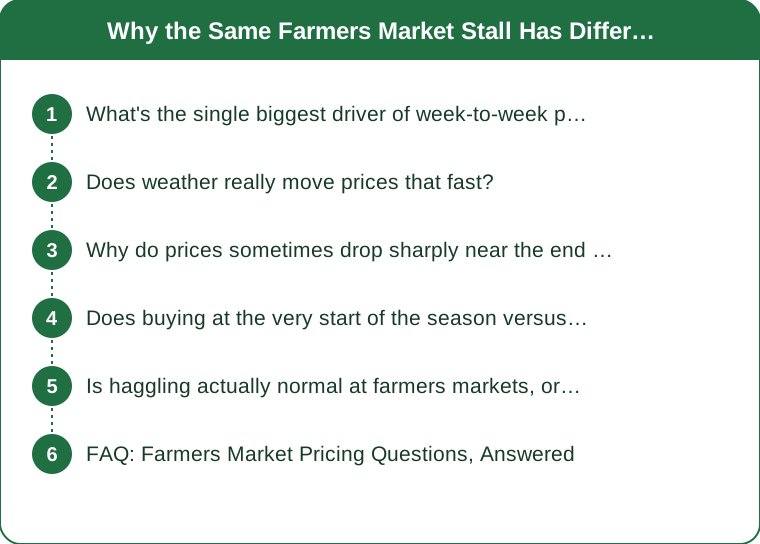
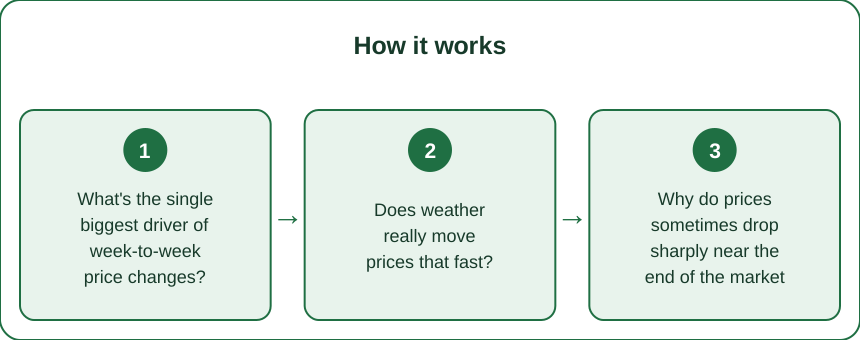
What’s the single biggest driver of week-to-week price changes?
Harvest volume that week. Farmers markets run on a much shorter, more direct supply chain than grocery stores, so a vendor’s price reflects what actually came out of the ground that week rather than a smoothed-out seasonal average set months in advance.
Does weather really move prices that fast?
Yes — a hot stretch, an early frost, or a heavy rain in the days before market can meaningfully change yield and quality for that single week, and vendors adjust price accordingly since the product in front of you was picked within the last day or two, not shipped from a stable, buffered supply.
Why do prices sometimes drop sharply near the end of the market day?
Unsold perishable produce has to go somewhere, and for most small vendors that’s either a discount at closing time or a loss — end-of-day price drops on items that won’t hold until next week are common and predictable, not a special favor.
Does buying at the very start of the season versus peak season change the price pattern?
Early and late season items are typically priced highest because supply is genuinely limited at the edges of a growing window, while peak-season abundance is when the same item is usually cheapest and most consistent from vendor to vendor.
Is haggling actually normal at farmers markets, or is that a myth?
5 Things Worth Knowing About Farmers Market Pricing:
- Small, respectful asks near closing time are far more accepted than haggling mid-morning at full stock.
- Asking about a bulk price for a larger quantity is a normal, expected question, not haggling.
- Price comparison between vendors selling the same item that day is a completely normal and expected part of shopping the market.
- Vendors are far more receptive to “what’s your best price on the last of this” than a flat lowball offer.
- Building a regular relationship with one vendor over several weeks tends to earn better informal pricing than any single haggle.
FAQ: Farmers Market Pricing Questions, Answered
Why does the same vendor sometimes charge more than a nearby stall for the same vegetable?
Growing method (organic certification, labor-intensive varieties), scale of operation, and how far along in the harvest they are all factor in — it’s rarely a straightforward apples-to-apples comparison even when the produce looks identical.
Is it worth arriving early or late to get the best price?
Arriving early gets the best selection at full price; arriving in the final 30-60 minutes gets the best price but reduced selection — which one matters more depends on whether you’re shopping for something specific or general.
Do prices tend to drop as the growing season goes on?
Generally yes for items at peak abundance, since supply increases through the middle of a season before tapering again near the end — tracking one or two staple items week to week is a good way to learn your market’s actual rhythm.
TL;DR:
- Weekly price swings mostly track actual harvest volume, not arbitrary markup
- Weather in the days before market meaningfully shifts that week’s price
- End-of-day discounts on perishables are normal, predictable, and worth timing for
- Early and late season items cost more simply because supply is genuinely limited then
- Respectful bulk or closing-time asks work far better than flat haggling
The swing isn’t random — it’s the harvest talking, and once you can read it, you can shop around it.
Keep Reading
This article is for general informational purposes only and is not medical advice. Always consult a qualified health professional for guidance specific to you.