Where Does All This Go? Small-Kitchen Market Storage Questions, Answered
Quick Answer: Most small-kitchen storage problems come from putting things in the fridge that should not be there. Tomatoes, stone fruit, potatoes, onions, garlic, winter squash, melons and basil all do badly refrigerated - which frees up a surprising amount of fridge space immediately. The three rules that solve the rest: separate the ethylene producers from the ethylene sensitive, do not wash anything until you use it, and process the most perishable third within twenty-four hours rather than trying to store it.
You got to the market early, everything looked excellent, and you now have more produce than your kitchen was designed to hold.
The instinct is to refrigerate all of it. That instinct will actively ruin about a third of what you bought, and it is also why the fridge is full.
Here are the questions people actually have, answered in the order they come up.
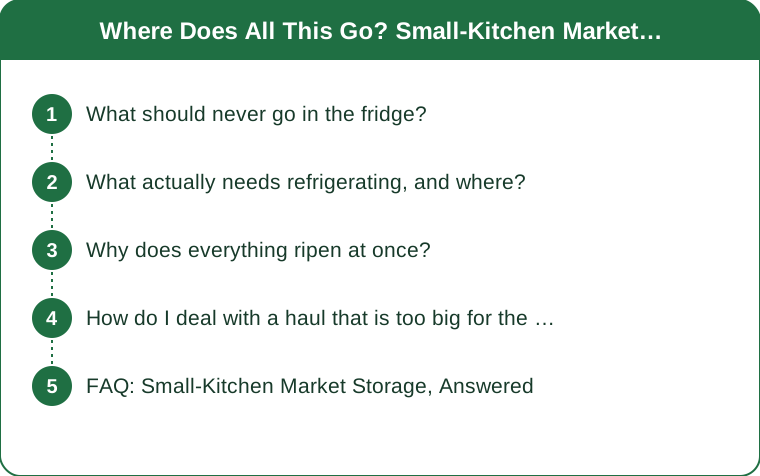
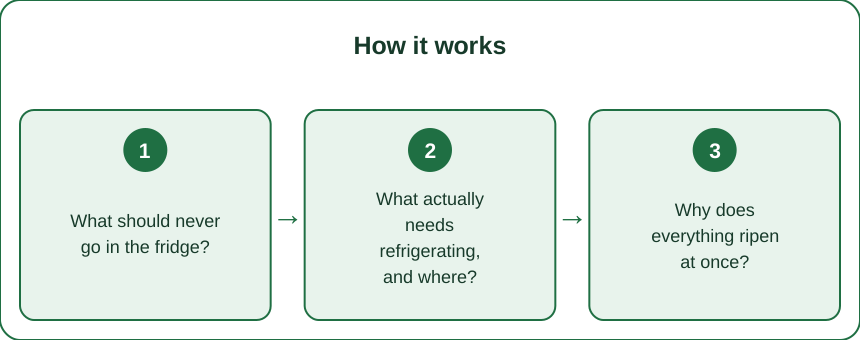
What should never go in the fridge?
More than you think, and getting this right frees up most of the space you needed.
Tomatoes. Below about 12°C, the enzymes responsible for flavour compounds shut down and the texture goes mealy. The damage is not reversible by bringing them back to room temperature. A ripe tomato on the counter, stem side down, is right. The one exception: a tomato that is fully ripe and about to go over can be refrigerated to buy a couple of days, accepting the flavour cost.
Stone fruit that is not yet ripe. Peaches, nectarines, plums, apricots. Cold arrests ripening permanently - a hard peach put in the fridge becomes a hard, mealy peach rather than a ripe one. Ripen on the counter, then refrigerate only once ripe if you need to hold it.
Potatoes. Cold converts starch to sugar, which makes them sweet, darkens them when cooked, and produces a genuinely unpleasant texture. Dark, cool, ventilated, and not near onions.
Onions and garlic. They need airflow and dryness; the fridge is humid. They also go soft and start to sprout.
Winter squash and pumpkins. Weeks or months at cool room temperature. The fridge shortens their life.
Melons, whole. Counter until cut, then refrigerate.
Basil. The one herb that genuinely hates the cold - it blackens within a day or two. Stems in a glass of water on the counter, like flowers.
And bread, which is not produce but takes up the space. Refrigeration makes bread stale considerably faster than the counter does. Counter for two days, freezer beyond that.
What actually needs refrigerating, and where?
Fridges are not uniform, and using the zones properly roughly doubles what fits.
Crisper drawers are humidity-controlled and are for leafy greens, herbs other than basil, and most vegetables. If your drawers have a slider, high humidity is for things that wilt - leaves, roots with tops on. Low humidity is for things that rot - fruit, peppers, courgettes.
Main shelves run colder at the back and warmer at the front. Put things that must stay cold at the back and things you want to remember at the front.
The door is the warmest part and it fluctuates constantly. It is genuinely the worst place for anything perishable. Condiments and drinks belong there.
What needs the fridge: salad leaves and herbs, berries, brassicas, sweetcorn (sugar converts to starch fast at room temperature - this is the one thing that is genuinely urgent), green beans, peas, courgettes, cucumbers, mushrooms, and anything already cut.
Two storage details that matter more than the location:
Do not wash anything until you use it. Surface moisture accelerates rot on essentially everything. The exception is leafy greens, which store better washed, thoroughly dried, and wrapped in a dry cloth or paper.
Take root vegetables’ tops off. Carrots, beetroot, radishes and turnips all lose moisture through their leaves after harvest. Removing the tops - and using them, since carrot and beet tops are edible - roughly doubles how long the root stays firm.
Why does everything ripen at once?
Ethylene gas, and it is the single most useful thing to understand about produce storage.
Some fruits release ethylene, a gas that triggers ripening. Other produce is sensitive to it and ripens - then rots - much faster in its presence. Put both in the same bowl and you have built a small ripening chamber.
Strong ethylene producers: apples, bananas, avocados, tomatoes, peaches, plums, pears, melons, figs.
Highly ethylene sensitive: leafy greens, broccoli, cucumbers, carrots, potatoes, courgettes, green beans, most herbs.
The practical rules:
Never store apples or bananas with leafy greens. This is the most common and most costly error - it can halve the life of a bag of salad.
Keep potatoes away from onions and apples. Potatoes with onions is a classic pairing and it is wrong; both the ethylene and the moisture exchange cause sprouting.
Use it deliberately when you want to. A hard avocado in a paper bag with a banana ripens in a day or two rather than a week. This is the only time you want the effect.
Ventilation is what limits it. Ethylene accumulates in enclosed spaces. A closed plastic bag concentrates it; an open bowl or a perforated bag lets it disperse. This is the main argument for not sealing produce in bags - most things last longer with some airflow.
And the small-kitchen version of this: if you only have one fruit bowl, put the ethylene producers in it and give the sensitive things the crisper drawer. That single separation solves most of it.
How do I deal with a haul that is too big for the space?
Stop trying to store it and process the perishable third instead.
The mistake is treating storage as the only option. A market haul in late August is heavy on things with short lives - tomatoes at their peak, soft fruit, herbs, greens, sweetcorn. Those were bought to be eaten, not held.
Sort it into three piles as you unpack:
Eat within two days. Soft fruit, salad leaves, herbs, sweetcorn, ripe tomatoes, anything with a bruise. This is your cooking plan for the next two days - not a storage problem.
Store for the week. Brassicas, root vegetables, apples, peppers, courgettes, onions. These are fine with normal handling.
Process today. Whatever is genuinely too much. Twenty minutes on the day you shop saves the whole haul.
The fastest processing methods for a small kitchen:
Roast the tomatoes. A tray of tomatoes with oil at 160°C for an hour concentrates them, and they freeze flat in a bag. This is the single best use of a late-August tomato glut, which is exactly what is happening at markets right now.
Blanch and freeze the greens. Two minutes in boiling water, into cold water, squeezed dry, frozen in portions. Takes up a fraction of the space raw greens do.
Freeze soft fruit on a tray first, then bag it. Spread out so the pieces do not fuse. Straight into smoothies or crumbles later.
Herbs into oil in an ice cube tray. Chopped herbs, olive oil, frozen. Far better than drying for soft herbs like basil and parsley.
And a small-kitchen truth: a freezer drawer holds a remarkable amount of processed produce and almost none of it unprocessed. Converting fresh to frozen is a space strategy as much as a preservation one.
FAQ: Small-Kitchen Market Storage, Answered
How do I stop herbs dying in two days?
Treat soft herbs - parsley, coriander, dill - like cut flowers: trim the stems, stand them in a glass with an inch of water, and cover loosely with a bag in the fridge. Basil gets the same treatment but stays on the counter, because it blackens in the cold. Hardy herbs like rosemary and thyme just need to be kept dry, wrapped loosely, in the fridge. The common failure is washing them on arrival, which is what starts the rot.
Is it worth buying less rather than storing better?
Honestly, often yes - and it is the answer nobody wants. Markets encourage volume buying because the produce looks superb and there is a social pressure to fill a bag. If you are consistently throwing things away, buying half as much twice as often produces better eating and less waste. A weekly market habit with a smaller basket beats a fortnightly haul that outlives your enthusiasm for it.
What is worth processing right now, at the end of August?
Tomatoes, first and foremost - they are at peak volume and lowest price, and roasted tomatoes freeze beautifully. After that, soft fruit for the freezer, basil into oil cubes, and any glut of courgettes grated and frozen for later. This is the last few weeks of the summer produce peak, and what you process now is genuinely worth having in November when the market looks completely different.
TL;DR:
- Tomatoes, unripe stone fruit, potatoes, onions, garlic, squash, whole melons and basil should not be refrigerated - which frees up the space you needed.
- Use the fridge zones: crisper for leaves and vegetables, back of the shelf for cold, door for nothing perishable.
- Separate ethylene producers from ethylene sensitive. Apples and bananas next to salad leaves halves the salad’s life.
- Do not wash until you use it, and take the tops off root vegetables.
- Sort the haul into eat-in-two-days, store-for-the-week, and process today - twenty minutes of roasting and blanching saves the rest.
A small kitchen is not the constraint. Refrigerating things that should be on the counter is.
Keep Reading
This article is for general informational purposes only and is not medical advice. Always consult a qualified health professional for guidance specific to you.