Late August at the Market: The Questions Worth Asking Every Stall
Quick Answer: Late August is the only point in the year when peak summer produce and early autumn produce sit on the same table, which makes it the hardest time to judge what is actually at its best. The three questions that resolve almost everything: when was this picked, is this the start or the end of its season, and what would you buy today if you were me. The third one gets you better information than the first two combined.
The stall that answers all three happily is the stall to build a relationship with.
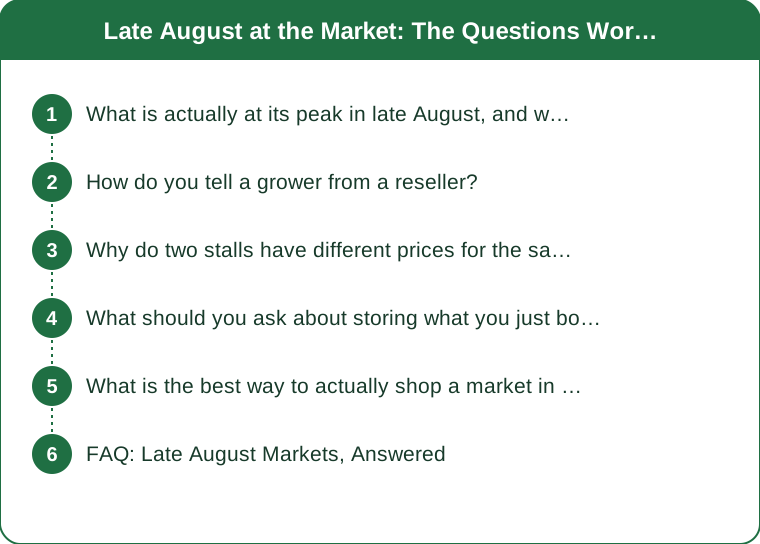
What is actually at its peak in late August, and what is finishing?
Two categories are peaking, one is finishing, and one is just arriving - and they are all on the same table.
At absolute peak right now:
- Tomatoes, which are at their best of the year and will decline noticeably within weeks. This is the fortnight to buy in quantity if you preserve anything
- Sweetcorn, at its sugar peak. Corn converts sugar to starch quickly after picking, which is why picked-this-morning matters more here than for almost anything else
- Stone fruit - peaches, nectarines, plums - in their final strong weeks
- Peppers and aubergines, which need accumulated heat and are only now fully ripe
- Melons, which are at their sweetest
Finishing, and worth buying now:
- Soft summer berries, which are past their best in most regions
- Courgettes, still abundant and increasingly seedy
- Green beans, which get tougher as the season closes
Just arriving, and often better in a few weeks:
- Winter squash, which is being harvested but improves with a curing period. Squash bought now and stored for a few weeks is sweeter than squash eaten immediately
- Apples, with early varieties only. The good storage varieties come later
- Autumn greens - kale, chard - which improve after the first cool nights
The question that sorts them. “Is this the start or the end of its season?” Early-season items are often at their most expensive and least developed; end-of-season items are cheapest and frequently at their best. Both facts are useful and neither is on the sign.
How do you tell a grower from a reseller?
Four signals, none of which require confrontation.
Ask a specific growing question. “How was the heat for you this year?” or “which variety is this?”
- A grower answers immediately and often at length, because it is the thing they think about
- A reseller gives a general answer and moves on
Look at what is on the table together.
- A single farm’s table shows what one piece of land produces in one week, which means gaps, inconsistent sizes, and a limited range
- A table with every vegetable in perfect uniform size, all season long, is a wholesale table. Uniformity is the strongest single signal
Check for variety names.
- Growers name varieties - Sungold, Brandywine, Honeycrisp - because varieties are choices they made months ago
- “Tomatoes” with no further information usually means the stall did not select them
Look at the condition and the packaging.
- Field-picked produce has variation, occasional soil, and no wax coating
- Wholesale boxes under the table are visible at most markets if you look
Why this matters beyond principle. A grower can tell you when it was picked, how to store it, and what will be good next week. That information is the actual value of a farmers market, and it is not available from a reseller at any price.
A note on fairness. Many markets explicitly permit resellers and label them, and there is nothing dishonest about it. The point is knowing which conversation you are in, not judging the stall.
Why do two stalls have different prices for the same thing?
Five legitimate reasons, and only one of them is about the produce being better.
Growing method. Certified organic carries real cost - certification fees, lower yields, more labour. A 30 to 50 percent premium is normal and reflects actual expense. Many small farms grow to organic standards without certifying, because certification is expensive for a small operation. Ask “do you spray?” rather than looking for a label.
Variety. Heirloom tomatoes yield less per plant, bruise more, and store worse than commercial varieties. The price difference is mostly loss and handling, not margin.
Harvest timing. Picked this morning versus picked two days ago is a genuine cost difference, because it means an extra early start and less flexibility. For corn, salad and berries this is the difference you can taste; for squash and onions it barely matters.
Scale. A larger farm has lower per-unit costs. The small stall is often more expensive for reasons that have nothing to do with quality.
Position in the season. Early and late in a crop’s window, supply is small and prices are high. Mid-season is when the price drops and, usually, when the quality is best - a useful thing to know if you are buying to preserve.
What is worth paying more for, specifically:
- Anything where freshness is the point - corn, salad, berries, herbs
- Varieties you cannot buy in a supermarket, which is most of the actual reason to be there
- Things you will eat within two days
What is often not worth a premium:
- Storage crops - onions, potatoes, winter squash - where the difference between stalls is small
- Anything you will cook down heavily, where texture and subtlety are lost anyway
What should you ask about storing what you just bought?
This is the highest-value question at any market and almost nobody asks it.
Ask: “how should I keep this, and how long will it hold?” Growers know, because they store their own crop, and the answer frequently contradicts what people do at home.
The answers that surprise people most:
- Tomatoes never go in the fridge. Below about 12C, the compounds responsible for tomato flavour degrade and do not recover. This is the single most common mistake with the best produce of the year
- Basil also hates the fridge and blackens. Keep it in water on the counter
- Sweetcorn does go in the fridge, immediately, in its husk. Cold slows the sugar-to-starch conversion
- Stone fruit ripens on the counter and then moves to the fridge once soft, not before
- Winter squash wants a cool dry room, not a fridge, and improves over weeks
- Onions and garlic want dark, dry and airy, and must not be stored next to potatoes - each shortens the other’s life
- Leafy greens want a damp cloth and a container, not a plastic bag alone
The ethylene question, which explains a lot of unexplained spoilage. Some produce emits ethylene gas and some is highly sensitive to it.
- Emitters: apples, stone fruit, tomatoes, melons
- Sensitive: leafy greens, broccoli, cucumbers, herbs
- Storing them together accelerates spoilage substantially, which is the reason half a fridge drawer goes off in three days
On buying in quantity in late August, which is worth doing:
- Tomatoes at peak are worth buying by the box for freezing, roasting or sauce. Freezing whole tomatoes on a tray works and is far less effort than any other method - the skins slip off as they thaw
- Ask about seconds. Most growers have slightly damaged produce at a substantially lower price, and for anything cooked it is identical. You often have to ask, because it is not on display
- Corn freezes well after blanching and is at its cheapest right now
What is the best way to actually shop a market in this season?
Walk it once before buying anything, and change what you carry.
The full lap first. Late August markets have the widest range and the widest price spread of the year. A single lap before buying takes four minutes and routinely changes what you buy, especially when the same item appears at three stalls at three prices.
Timing, and the genuine tradeoff:
- First hour: best selection, everything present, and the growers have time to talk. Best for anything specific
- Last hour: better prices, particularly on anything perishable, and growers would rather sell than transport. Best for buying in quantity
- Middle: worst of both - picked over and full price
What to carry, which changes in late August:
- A rigid basket or box, not a bag. Peak tomatoes and stone fruit bruise, and this is the fortnight when the best produce is also the most fragile
- A separate bag for greens, which need to stay away from anything heavy
- A cool bag if the walk home is more than 20 minutes in this heat. Corn and greens deteriorate quickly in a hot car
- Cash, because card systems fail and some small stalls do not take them
Building the relationship, which is where the real value is:
- Go to the same stalls repeatedly. Growers remember, and regular customers hear about what is coming, what is exceptional this week, and what will be over by Friday
- Ask what they are excited about. It is a better question than what is good, and it gets a genuine answer
- Ask what to do with something unfamiliar. Growers almost always know, and it is often the best cooking advice available anywhere
The one question worth ending on. “What should I buy today if I am only buying one thing?” It cuts through everything, it flatters nobody, and the answer is usually right.
FAQ: Late August Markets, Answered
What is best at the market right now?
Tomatoes and sweetcorn are at their annual peak, with peppers, aubergines and melons close behind. Stone fruit is in its final strong weeks.
How do I know if a stall grows what it sells?
Ask a specific growing question and look for uniformity. A single farm’s table has gaps and size variation; a table with everything in perfect uniform size all season is buying wholesale.
Why is the same vegetable twice the price two stalls away?
Growing method, variety, harvest timing, farm scale and position in the season all move price legitimately. Only some of those differences show up in the eating.
Should I shop early or late?
Early for selection and conversation, late for price on perishables. The middle of the market gives you the disadvantages of both.
How should I store peak tomatoes?
On the counter, never the fridge. Below about 12C the flavour compounds degrade permanently, and this is the best tomato fortnight of the year.
Is it worth asking for seconds?
Yes, and you usually have to ask because they are not displayed. For anything cooked, sauced or frozen, slightly damaged produce is identical and much cheaper.
TL;DR:
- Late August is the only time peak summer and early autumn produce share a table, which is why it is confusing
- Tomatoes and sweetcorn are at their annual best - buy in quantity now, not in three weeks
- Ask whether an item is at the start or the end of its season; end-of-season is often cheaper and better
- Never refrigerate tomatoes, and keep ethylene emitters away from greens and herbs
- Ask about seconds, ask how to store it, and walk the whole market once before buying anything
The information a grower gives you is worth more than the price difference between stalls. Ask for it.
Keep Reading
This article is for general informational purposes only and is not medical advice. Always consult a qualified health professional for guidance specific to you.