Farmers Market Questions About Shopping in the Rain, Answered
Quick Answer: A rainy market morning is usually the best value day of the week and the worst storage day. Fewer shoppers turn up, so vendors discount more readily and you get proper attention. But produce picked or handled wet spoils considerably faster - wet greens and berries can lose days of shelf life - so the rule is buy generously on hard produce and cautiously on soft. Arrive in the first hour, bring more bags than you need, and dry everything before it goes in the fridge.
Most market advice assumes a bright Saturday. The wet ones are a genuinely different event, and if you know how they work they are often the better trip.

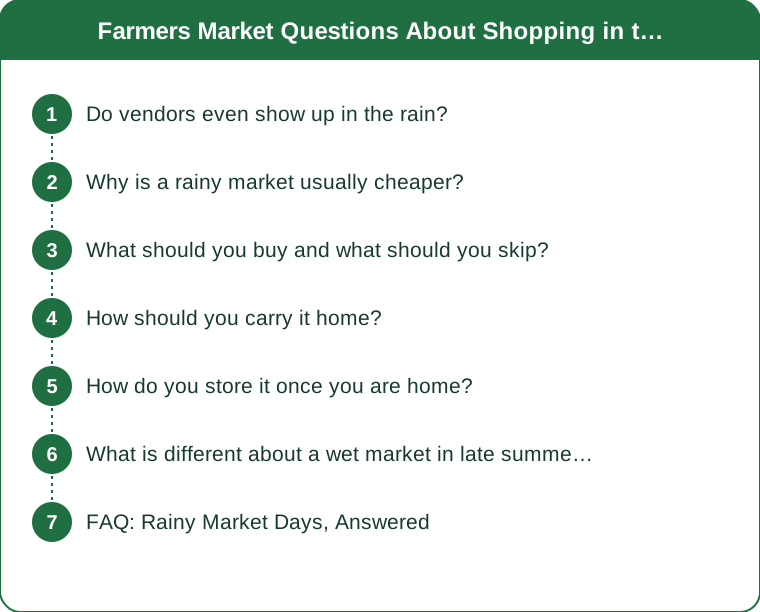
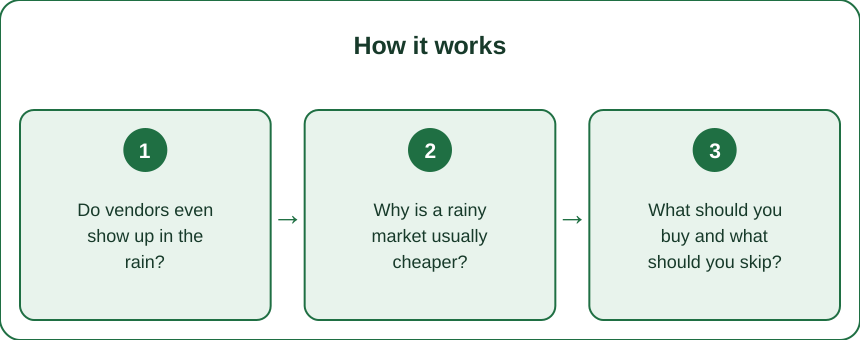
Do vendors even show up in the rain?
Most do, and fewer than usual - which is the whole reason the day works in your favour.
Produce growers almost always come. The vegetables were harvested, the van was loaded, and a wet morning does not change any of that. These are the stalls you can rely on.
Prepared food, baked goods, and craft stalls thin out most. Anything that suffers from humidity or needs a dry display is the first to skip a bad forecast. If you were going for bread and cheese specifically, check the market’s social account before you leave.
Flowers usually come and often discount hard, since cut stems do not keep to next week.
Will the market be cancelled?
Rarely for rain alone. Most markets cancel only for high wind, which makes canopies genuinely dangerous, or for lightning. A steady downpour is a normal trading day.
Should I go later to let it pass?
No - go earlier. On a wet day the good stock does not last longer just because there are fewer people; vendors often pack up early when trade is slow, and the first hour is when the full range is still out.
Why is a rainy market usually cheaper?
Because the vendor’s incentives change completely, and they change in your direction.
Perishable stock has a deadline. A grower who brought 40kg of tomatoes on a day when a third of the usual customers show up is looking at either a discount now or compost on Tuesday. The willingness to deal is real and it is highest in the last hour.
There is no queue. On a busy Saturday a vendor cannot spend four minutes talking to you about which variety keeps better. On a wet Wednesday they can, and that conversation is where the actual value of a market is.
Bulk offers appear. A rainy day is the best time to ask about a case price on anything you want to preserve - tomatoes for sauce, apples for the freezer, chillies to dry. Ask directly: what would you do on a full crate? That phrasing is normal and expected.
Is haggling rude?
On individual items, generally yes. On volume, at the end of the day, on perishables, it is standard practice and vendors expect it. The distinction is whether you are asking them to lose money or helping them avoid a loss.
Do prices go up in bad weather because of scarcity?
Not at a local market on a single wet day. That is a supply-chain effect over weeks, not a weather effect on a Saturday morning.
What should you buy and what should you skip?
This is where a wet day genuinely changes the shopping list, and the split is sharp.
Buy freely: root vegetables, squash, onions, garlic, apples, pears, cabbage, hard herbs like rosemary and thyme, anything with a skin or a shell. Rain does not meaningfully affect these and they will store exactly as normal.
Buy carefully: salad leaves, spinach, soft herbs, berries, ripe stone fruit, mushrooms. Wet greens and berries can lose several days of fridge life because surface moisture accelerates bacterial and mould growth. If they have been sitting uncovered in the rain, buy only what you will eat in two days.
Ask before you buy soft produce: was this picked in the rain or before it started? Produce harvested wet is more fragile than produce that got rained on for an hour in a crate. Vendors will tell you honestly - it is a normal question and it signals you know what you are doing.
A specific one for right now: late-season tomatoes split after rain. Split tomatoes are perfectly good and often discounted, but they must be used within a day or two. This is the best possible time to buy a crate for sauce and the worst time to buy them for a salad on Thursday.

How should you carry it home?
Wet produce plus a canvas bag is how a market haul turns into a mess before you reach the car.
Bring more bags than you need, and at least one that is not fabric. Canvas soaks through and then the bottom fails. A plastic crate, a cool bag, or a lined tote is the single most useful thing to have on a wet day.
Separate wet from dry at the stall, not at home. Damp greens packed against bread or against a paper bag of mushrooms ruins both.
Keep berries on top and level. Wet punnets collapse under weight far faster than dry ones.
Take a towel to the car. Obvious once you have done it, and almost nobody does it the first time.
Do I need a different bag for the walk versus the car?
If you are walking any distance, a backpack keeps your hands free for an umbrella and is genuinely the better option. Hand-carried bags in the rain is where dropped produce happens.
What about eggs?
Eggs are fine in rain, but the cartons are not - a soggy carton fails on the way up the stairs. Ask for a bag around it, or bring your own rigid container.
How do you store it once you are home?
This is the step that decides whether a rainy market haul was a bargain or a waste, and it needs doing before you sit down.
Dry everything before it goes in the fridge. Spread it on a towel on the counter for twenty minutes. This one step recovers most of the shelf life that the rain cost you.
Do not wash anything you are not eating today. Adding more water to already-wet produce is the most common mistake. Wash at the point of use.
Greens: dry thoroughly - a salad spinner is genuinely worth it here - then store with a dry paper towel in the container to absorb residual moisture. Change the towel after two days.
Berries: do not wash, do not seal. Store in a single layer in a ventilated container. If any are already soft, use those first, today.
Mushrooms: paper bag, never plastic. Wet mushrooms in a sealed bag go slimy within a day.
Root vegetables and squash: these actually want to dry off before storage. Leave them out overnight if they came in muddy and wet, then store cool and dark.
Herbs: dry, then stems in a jar of water in the fridge, loose bag over the top.
What is different about a wet market in late summer specifically?
The end of August adds a few things that will not apply in October.
It is still warm. Warm plus wet is the fastest spoilage combination there is, and it is worse than either alone. Produce sitting in a humid crate at 22C degrades noticeably faster than the same produce in a cold October drizzle. Get it home and dried faster than you would later in the year.
The glut is on. Tomatoes, courgettes, beans, and stone fruit are all at peak volume, which means the discount on a slow wet day is at its steepest for the year. This is the single best week to buy in bulk for preserving.
Split and blemished fruit is everywhere after rain. Understand what you are buying: it is perfect for cooking, freezing, and preserving, and it is not going to sit in a bowl for a week. Priced accordingly, it is the best value on the table.
The changeover is starting. Early apples, the first squash, and the last of the soft fruit overlap right now. A quiet wet morning is the ideal time to ask a grower what is finishing and what is starting - the answer shapes the next month of your shopping and you will never get that conversation on a busy sunny Saturday.
FAQ: Rainy Market Days, Answered
Is produce that has been rained on less nutritious?
No. Surface water affects storage life, not nutritional content.
Should I bring cash?
Yes, and more than usual. Card readers are the most weather-sensitive equipment at a market, and connectivity drops when everything is under canopies. Cash also makes a volume deal easier.
What if it starts raining after I arrive?
Head for the vendors under solid cover first and do your soft-produce shopping there. Buy hard produce last - it does not care.
Is there a best time of year for a rainy market trip?
Right now, for the glut and the discounts. In deep winter the same wet day gives you fewer vendors and much less choice, so the bargain does not materialise in the same way.
TL;DR:
- A wet market is usually the best value and the worst storage day of the week.
- Buy freely on hard produce, carefully on greens, berries, and mushrooms - wet soft produce loses days of life.
- Ask about crate prices on perishables; a slow wet morning is when vendors genuinely want to deal.
- Bring a non-fabric bag, extra bags, and a towel for the car.
- Dry everything for twenty minutes before it goes in the fridge. This one step recovers most of the lost shelf life.
The rainy Saturday is the trip most people skip, which is exactly why it is the one worth taking. Fewer shoppers, better prices, and a grower who has time to talk to you.
Keep Reading
This article is for general informational purposes only and is not medical advice. Always consult a qualified health professional for guidance specific to you.