What Changes at the Farmers Market Between August and October?
Quick Answer: Late August to October is the market’s widest window - summer crops are still coming in while fall crops arrive, so you get overlap you will not see again until next year. Tomatoes, peppers and stone fruit are peaking and about to end; winter squash, apples and hearty greens are starting. Buy the ending crops for preserving now and the starting crops for storage, and expect prices on the summer items to drop before they disappear entirely.
This stretch confuses people because the market looks stable while the underlying availability changes week to week.
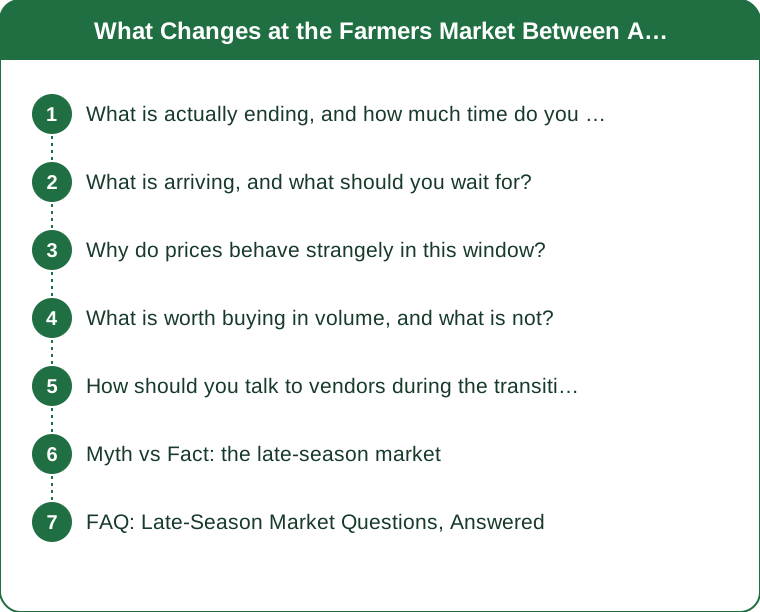
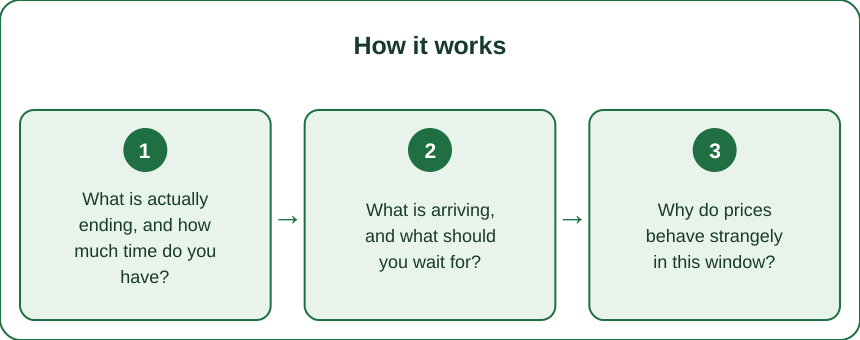
What is actually ending, and how much time do you have?
Stone fruit is on its last stretch. Peaches, nectarines and plums in most regions run through late August into September, and the quality curve falls off quickly at the end. If you want to freeze or can, this is the window and it does not extend.
Tomatoes peak now and then stop abruptly. They will be abundant and cheap for a few weeks and then a cold night ends the field crop. That price drop is the signal, not the start of a long season.
Corn, cucumbers and summer squash follow a similar shape. Corn quality in particular declines fast once nights get cool.
Basil is the earliest casualty. It is damaged by cold well above freezing, so it often disappears before anything else does.
The practical rule: when a vendor drops the price on a summer crop, they are not running a promotion. They are telling you the season is closing. That is the week to buy in volume.
What is arriving, and what should you wait for?
Winter squash arrives now but improves with a few weeks of curing. Butternut, delicata, acorn and kabocha bought in September will taste better in October, since curing converts starch to sugar. There is no reason to wait to buy - it stores for months.
Apples start early and continue. Early varieties are softer and less complex; the storage varieties arrive later and are worth waiting for if you care about texture.
Hearty greens get better as it cools. Kale, collards and chard sweeten after cool nights, which is a genuine chemical change rather than a marketing claim - plants convert starches to sugars as a cold response.
Root vegetables improve for the same reason. Carrots harvested after the first cold snap are noticeably sweeter than the same variety in July.
Wait on: brassicas like Brussels sprouts, which are considerably better after frost. Do not wait on: anything you plan to preserve from the summer side of the ledger.
Why do prices behave strangely in this window?
Because two opposite forces are operating simultaneously and the balance shifts weekly.
Ending crops get cheap because supply exceeds demand at the tail. A grower with a field of tomatoes that will not survive the first cold night would rather sell them at a discount than lose them. This is where the best value at the market all year sits.
Starting crops are expensive because supply is thin. The first apples and the first squash carry an early-season premium, and it drops within two to three weeks.
The overlap makes comparison shopping unusually productive. Two stalls with the same crop can be at very different points in their own season, so prices diverge more now than at any other time.
What to do with that: buy your preserving volume from the ending side, buy your storage items when the early premium falls off, and shop the last hour if you want the ending crops at their lowest - though the selection will be thinner.
What is worth buying in volume, and what is not?
Worth it: tomatoes for sauce. Ask for seconds or canning tomatoes. Vendors often have blemished fruit at a substantial discount that is identical once cooked, and many will not have it out on display.
Worth it: peppers for freezing. They freeze well with no blanching, sliced and laid flat. One of the highest-value bulk buys of the year.
Worth it: winter squash. Cures and stores for months in a cool room, and it takes zero processing.
Worth it: apples if you have cold storage. Storage varieties hold for a long time in a refrigerator or a cold garage.
Not worth it: corn in volume. Sugars convert to starch quickly after picking, so it does not hold and freezing it is a lot of labor for a modest result.
Not worth it: soft summer greens. They are on their way out and will not store past a few days.
Ask about seconds explicitly. It is the single most useful question in this window and most shoppers never ask it.
How should you talk to vendors during the transition?
The questions that work now are different from midsummer questions.
How many more weeks do you have on this? The most valuable question of the season, and vendors answer it honestly because it helps them sell.
Do you have seconds for canning? Frequently yes, frequently not on display, and frequently at half price or less.
When does your first {crop} come in? Lets you plan and signals that you are a repeat customer, which affects how much information you get over time.
Which variety stores best? Especially for apples and squash, where the difference between varieties in storage life is large and the vendor knows it precisely.
Timing matters too. Early in the market gets the best selection of the arriving crops. The last thirty minutes gets the best prices on the ending ones. If you are shopping the transition deliberately, those are two different trips - or a decision about which side of the ledger you care about more this week.
Myth vs Fact: the late-season market
Myth: The market gets worse after Labor Day. Fact: it gets different, and in many regions the September and October markets carry more total variety than July does, because two seasons overlap.
Myth: End-of-season produce is lower quality. Fact: the last tomatoes of a field crop are frequently the best-tasting of the year, since they ripened through cooler nights. Discounted does not mean declining.
Myth: If it is at the market, it is local and in season. Fact: rules vary by market and some vendors resell. Ask where it was grown - a genuine grower answers immediately and specifically.
Myth: You should preserve everything. Fact: preserving is worthwhile for a few high-value items you will actually eat. A pantry of ambitious September canning that nobody opens is a common and slightly demoralizing outcome.
Myth: The market closes when summer ends. Fact: many markets run well into fall or year-round, and the cold-season market has genuinely good root vegetables, storage crops and greens that most shoppers never see.
FAQ: Late-Season Market Questions, Answered
When exactly does the transition happen?
It varies widely by region and by year, but the practical signal is the first stall selling both stone fruit and winter squash. That overlap week is the start, and it usually runs three to six weeks.
Is it cheaper to buy in bulk at the end of a crop’s season?
Usually yes, and often dramatically - especially if you ask about seconds. This is the best value window of the entire market year for preserving.
How do I store winter squash properly?
Cool, dry and dark, around 50 to 60F, not in the refrigerator, and not touching each other. A basement, garage or cool closet works. Whole and uncut, most varieties hold for two to three months and some considerably longer.
What should I buy this week if I only buy one thing?
Tomatoes if they are still peaking - the window is short and the difference between a field tomato in September and anything available in February is the largest quality gap in produce.
TL;DR:
- Late August to October is the market’s widest window, with summer and fall crops overlapping for a few weeks.
- A price drop on a summer crop is a season-ending signal, not a promotion - that is the week to buy in volume.
- Buy squash and apples for storage, and ask explicitly about seconds for preserving.
- Greens and roots genuinely sweeten after cool nights; corn and soft greens are not worth bulk buying.
- The best questions right now are how many more weeks and do you have seconds.
This is the one stretch of the year where the market rewards paying attention week to week. Everything changes, most of it changes fast, and the prices on the way out are the best you will see.
Keep Reading
This article is for general informational purposes only and is not medical advice. Always consult a qualified health professional for guidance specific to you.